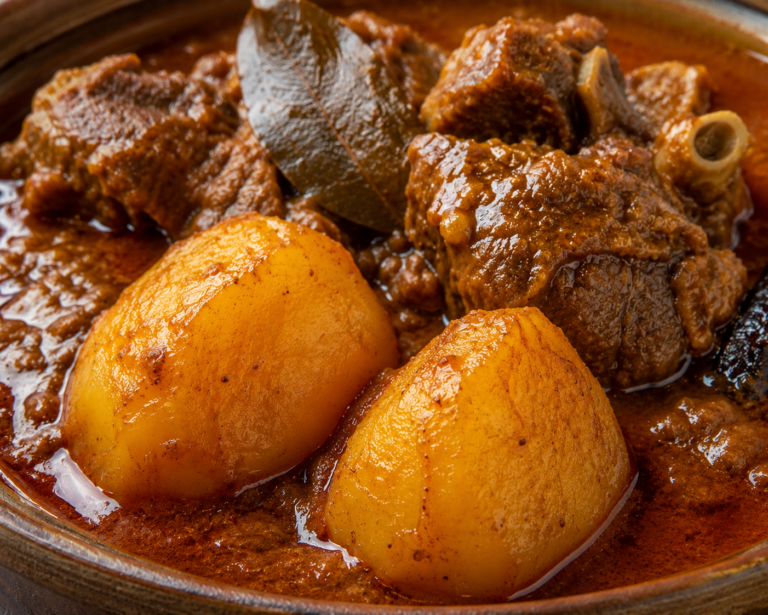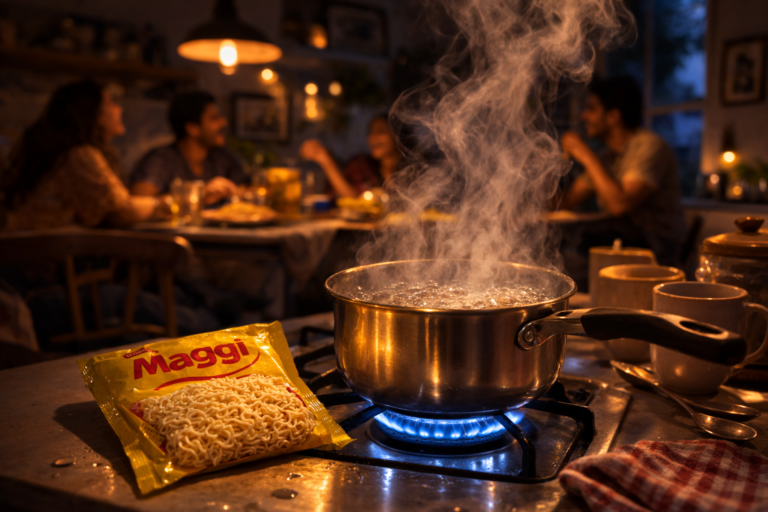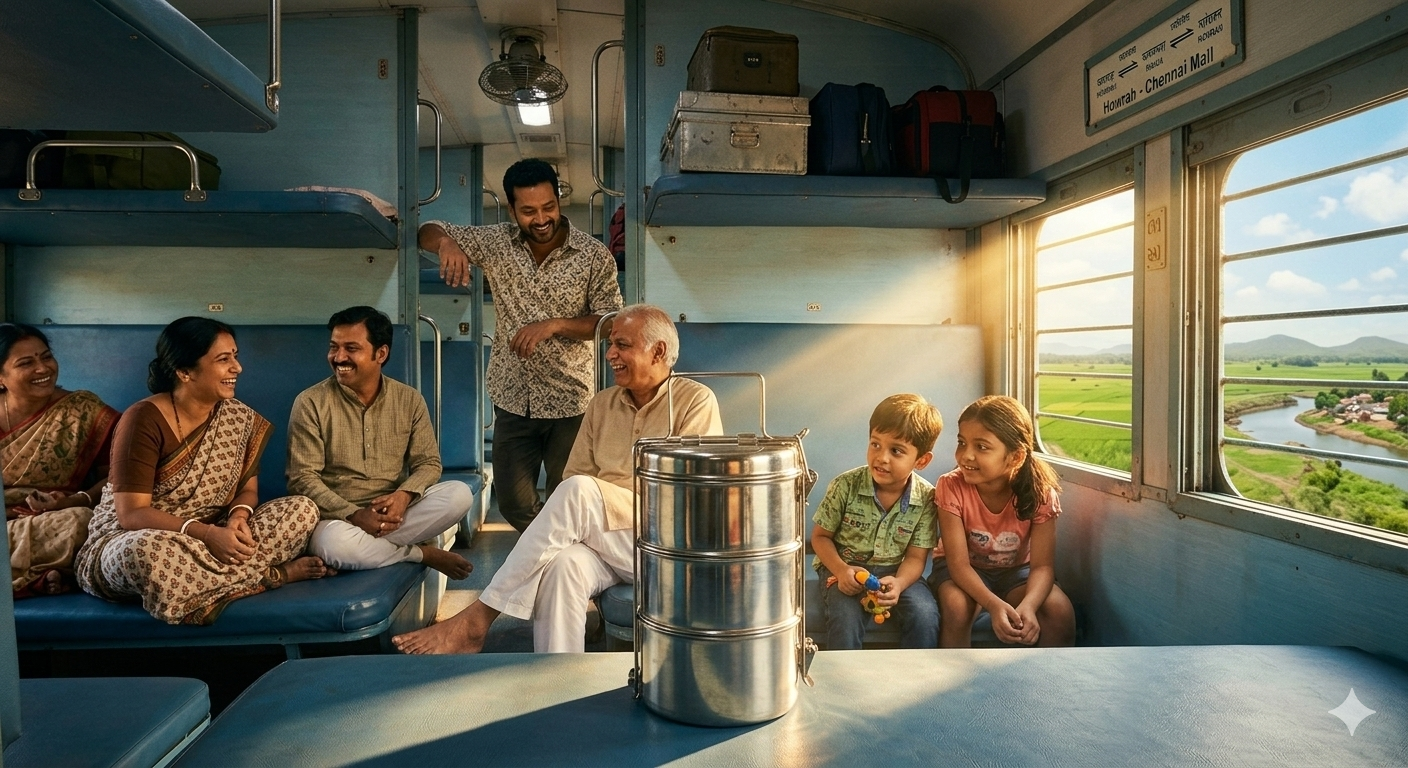
There’s a beautiful alchemy that happens when you combine Indian trains, tiffin boxes and the fun of long-distance childhood train travel. Pack into this alchemy, childhood nostalgia and in an instant this beats boring airline travel with food in plastic trays hands down Airlines give you peanuts (like literally!) Indian trains give you poetry.
Many of us grew up believing that train journeys weren’t complete without the tiffin carrier—that glorious tower of stainless steel containers stacked one atop another, held together by a precarious metal handle that always threatened to give way at the most inconvenient moment. Not unusual therefore was the regular sight of a rope trying in its determined ugliness to hold the metal handles together!
During my entire school life, Baba was posted first at thermal power stations and later at hydel power plants, all long ways away from Kolkata. Santaldih (in Purulia district of West Bengal) was the key place for Ma and me to visit all throughout my junior school days. And the train journey would be incomplete without planning (yes, that bit was most important) and then packing a tiffin carrier. Remember, those were the days when AC coaches and train serving hot lunch was not our thing. Sleeper coach travel was the norm and a very happy one at that! 🙂
For those who would travel in large groups, packing for the train journey would be no less precise than preparing for a military operation requiring strategic planning, careful execution and enough food to feed a small battalion. Yes, even if that was just an overnight journey. The ‘what-ifs’ would be the master strategy. ‘What if the train is late? What if we get hungry? What if the food at the station is terrible?’ All valid points indeed. Indian trains would run on their own philosophical understanding of time and station food was a gamble best avoided.
My cousin’s family would usually travel in large groups, no less than ten. And I’ve seen their kitchen transform into a command central the day before travel. With the meticulous precision of dinner on night one, then the following day’s breakfast and often lunch thereafter. And what any train food was incomplete without were snacks! Yes, loads of it, even if the journey lasted less than 24 hours. And snacks were when that master strategy ‘what ifs’ reigned again. Savoury with tea was a norm, but ‘what if’ any of us got a sudden sweet-tooth attack! ‘What if’ cooked fries got soggy, hence let’s also carry some dry snacks. Extending this same logic to lunch was something like, ‘What if’ the fish smelled (though deep fried first) and bothered co-passengers, do we carry fried chicken instead?
Multiple burners going, the pressure cooker hissing its urgent warnings, my cousin’s kitchen would turn into nothing short of a battleground, her mom and grandma busy shuffling between pots and pans with the baffling intensity and focus of people with a purpose. I have been on train journeys with them a couple of times and the discipline and architecture of the tiffin carrier never varied.
Bottom layer for the main lunch carrier would be rice. Always rice. The foundation upon which all good journeys were built. Sprinkled with enough ghee for that urge to open the box (and sufficiently distract fellow passengers with that invigorating aroma).
Second layer: A dry sabji (torkari, for Bengali readers). Amongst our favourites was aloo posto (potatoes in poppy seed paste). It travelled well, tasted even better cold than hot (not that anyone had a choice, hot containers were not in fashion) and had the remarkable ability to make you feel instantly at home regardless of which godforsaken railway station you were stopped at for inexplicable reasons.
Third layer: something fried of course. Begun bhaja (fried brinjals, guaranteed to be oily and soggy, nonetheless lapped up to finish), aloo bhaja (fried potatoes), deep fried alu phoolkopi bhaja (fried potatoes and cauliflower) and or Bhindi bhaja (Third layer: something fried of course. Begun bhaja (fried brinjals, guaranteed to be oily and soggy, nonetheless lapped up to finish), aloo bhaja (fried potatoes), alu phoolkopi bhaja (fried potatoes and cauliflower) and or Bhindi bhaja (fried ladyfinger). Or if a journey was particularly blessed, fish fry or dry chicken. Often thrown into this top layer was pickle. Note that the minutest detail was not to be missed, such was the clarity of purpose in train journeys.
And there lay the holy trinity of Bengali train food! The dynamics of tiffin box in the middle class Indian household was the divine mix of science and the arts. The science bit dealt with preservation and simplicity, while the art was devoted to taste and satiation! And yes, especially a Bengali train food imparted that special training of deftly being able to ignore the sniffing nose of co-passengers not particularly welcoming of the smell of your fried fish or chicken!
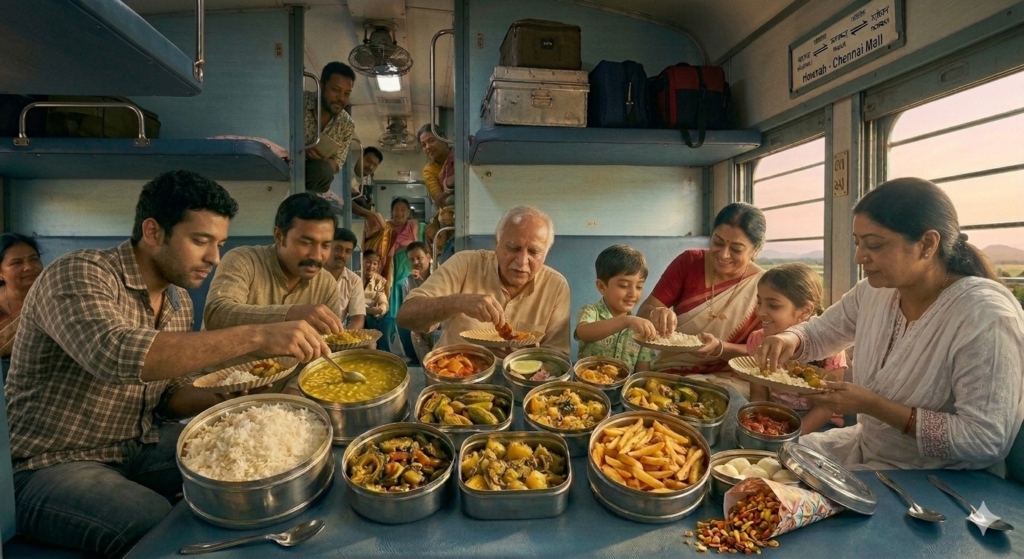
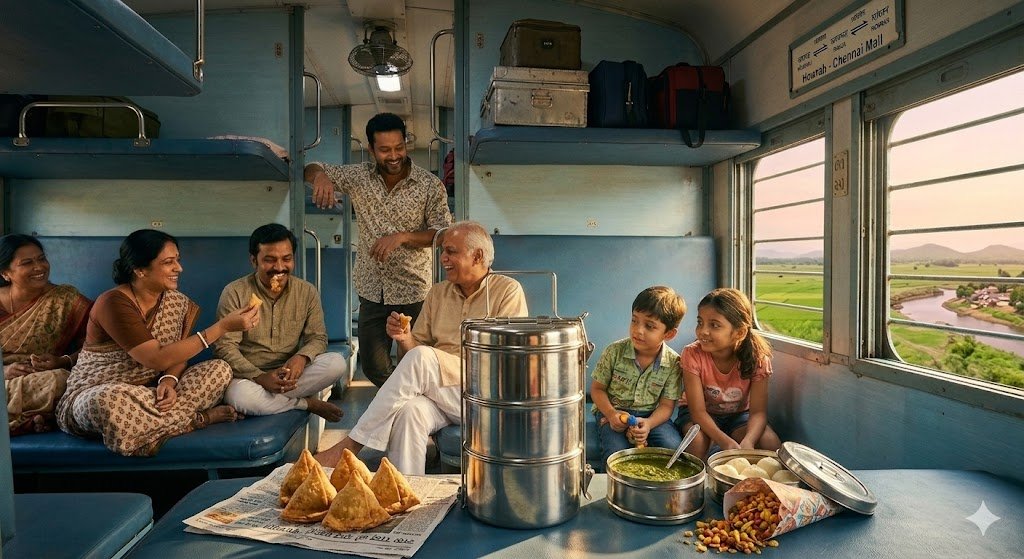
The beauty of the tiffin box system lay in its democracy. Everyone carried one. The businessman and the college student alike, or like my cousin’s family of ten who rolled into a compartment, treating the entire journey as an extended picnic. Come mealtime, out came the tiffin boxes. And suddenly the entire compartment would smell like home. Everyone’s different home, which created the most wonderfully chaotic olfactory experience. Add to that the clinking of spoons and that completed the picture of the mad medley orchestra of train meal times.
There used to be an unwritten code of conduct around train food. You offered some of yours to your fellow passengers. They offered some of theirs to you. I’ve eaten things on trains I couldn’t identify. Cutlets made from no-idea what but extremely tasty, homemade sweets, masala papad, parathas with butter and the list was endless. Each time, it was a revelation. And each time, as the train lurched ahead on its rumbling lazy journey, a bond was built through sharing of food with total strangers. Thank God, “Do not accept food from strangers” was not in vogue those days! They might title a blog today “Fostering bonds through food during train journeys”! During my childhood days, there was nothing known as blogs; yet the relations fostered, through food and carefree banter with strangers. And those remained etched in our memories lifelong.
The tiffin box tagged along home with you. Over unfamiliar terrains and dark nights, it packed in belonging and memory. The comfort of familiar flavours whilst making unfamiliar journeys. You’re hurtling through landscapes you’ve never seen before, past fields and villages and occasionally a cow standing on the tracks looking utterly unbothered by the approaching train. Outside the window, India continued to unfold in all her chaotic glory. Inside your compartment, you’re munching on a delicacy your grandmother cooked and packed for you and suddenly you’re both everywhere and home all at once.
Modern travel has trashed the tiffin career culture. Today we have convenience, speed and neat and hygienic tiffin packs handed to us by people in uniform. We have long long back quit sleeper coach travel. Travel is now branded, my food is the same as all my co-passengers’. Gone are the erstwhile glorious, democratic, chaotic train travels, where meal times spelt diversity. There’s a romance to train travel that air travel simply can’t match. Planes get you there faster, true. But trains give you time. Time to think. Time to talk to strangers. Time to pause and reflect. Time to eat your meal slowly, watching the landscape change, feeling the rhythm of the rails, becoming part of the journey rather than simply enduring transit.
My parents to this day, have tried to maintain the tradition of train travels. My Ma especially loves the romance of travelling by train, sitting by the window and watching the myriad of stunning landscapes pass by. However, the tiffin box culture has died, courtesy AC coaches and men in uniform.
The next time you take a train—and I hope you do, because trains are where India reveals herself honestly—pack a tiffin box. Doesn’t have to be elaborate. Doesn’t have to be a four-tiered architectural marvel. Just something from home. Something that tastes like belonging, something cooked at home on the gas burner. Something you can munch on slowly, at your pace, as you watch the world roll by.
While in the sleeper coach, someone’s stretched arms are still balancing today the various dabbas of the tiffin box from falling off the seat. To me, that seems like lost ingredients of a movie as ageless as the tracks of the train.
Safe travels. Pack well. And if you see someone struggling with an overloaded tiffin carrier on Platform Number 3, about to board a sleeper coach, take a pause and watch them. They’re carrying someone’s love, someone’s memory from home. Happy travels. 🙂